Unit I Austin Chalk · ~84,000,000 years ago
First, put Texas underwater.
In the Late Cretaceous there was no Austin, no Hill Country skyline, no Texas at all in any recognizable sense. Central Texas lay at the bottom of a warm, shallow arm of the ancient Gulf of Mexico.
Overhead, the sea was quietly building the ground the city now stands on. A steady rain of microscopic plankton skeletons drifted to the bottom, piling up century after century into the soft white stone geologists call the Austin Chalk — the same chalk that makes creek beds around town glow pale on a summer day.
Mosasaurs — sea lizards the size of school buses — cruised these waters. Ammonites coiled past in the currents. Sharks left their teeth in the mud. And far below all of it, something else was on the move.
Unit II Phreatomagmatic blasts · ~79–83,000,000 years ago
Then the sea floor exploded.
When magma at roughly 2,100°F met the waterlogged muck of the sea bed, the water didn't boil. It detonated — flashing instantly to steam and shattering the molten rock into ash.
Geologists call this a phreatomagmatic eruption, and Pilot Knob ran the full program. It began as a maar — a submarine explosion crater blasted into the sea floor. Blast after blast pulverized fresh magma and hurled it upward through the water column in jets of steam, ash, and volcanic bombs.
As the debris piled up, the volcano climbed toward the surface. When its vent finally breached the waves, it entered its most violent phase: Surtseyan eruptions, named for Surtsey, the island that erupted out of the North Atlantic off Iceland in 1963 — a live rerun, 80 million years later, of exactly what happened here.
Unit III Tuff cone & beach rock · ~80,000,000 years ago
For a while, Austin had a beach.
Once the steam blasts built the cone above the waves, the eruption calmed. With seawater no longer flooding the vent, quieter flows of basalt lava capped the ash pile — and Pilot Knob became a genuine volcanic island in the Cretaceous Gulf.
Then the ocean got to work on it. Waves ground the ash and lava into black volcanic sand and mixed it with the shells of the sea life crowding the island's warm shallows. Real beaches formed — beaches with surf, shell beds, and volcanic black sand, sitting where Austin's southeastern suburbs are now.
Those beach deposits hardened into stone, and here's the part locals never believe: that stone, spread in a sheet for miles north of the volcano, is what Onion Creek pours over at McKinney Falls State Park. Both Upper and Lower Falls run across the lithified beach of an extinct volcano. Every summer, thousands of swimmers do cannonballs off of it without knowing.
Unit IV Erosion & exposure · 80,000,000 years ago → today
What 80 million years leaves behind.
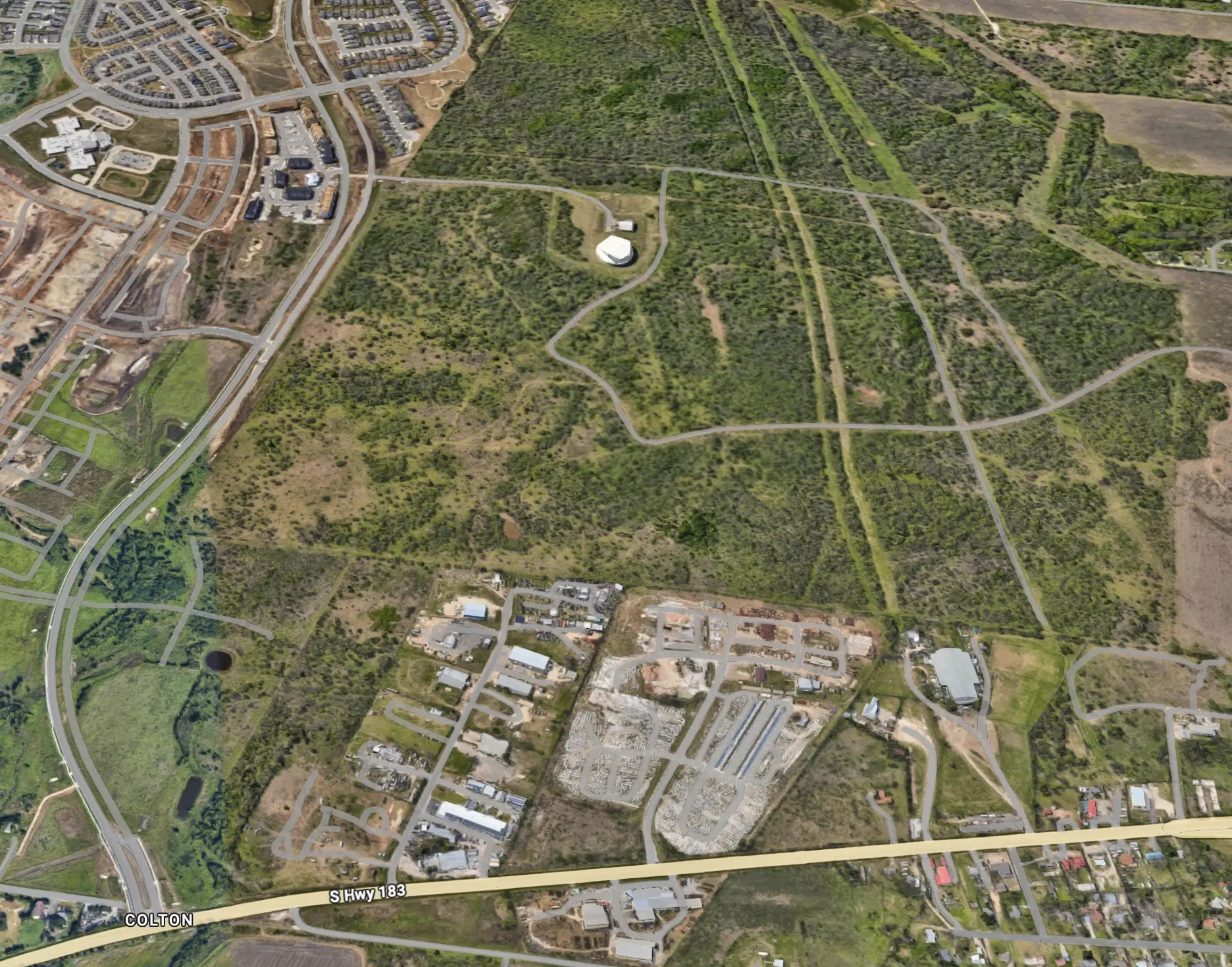
The sea drained away. The soft ash cone washed off. What survived is the volcano's dense basalt heart — four low, rounded hills in a two-mile ring, with the tallest, Pilot Knob itself, rising to 711 feet.
It earned its name honestly: for centuries the knob was a landmark — a “pilot” — guiding travelers across a nearly featureless coastal plain. Today it guides jets instead; planes on approach to Austin–Bergstrom pass close enough for a window-seat view of the crater ring.
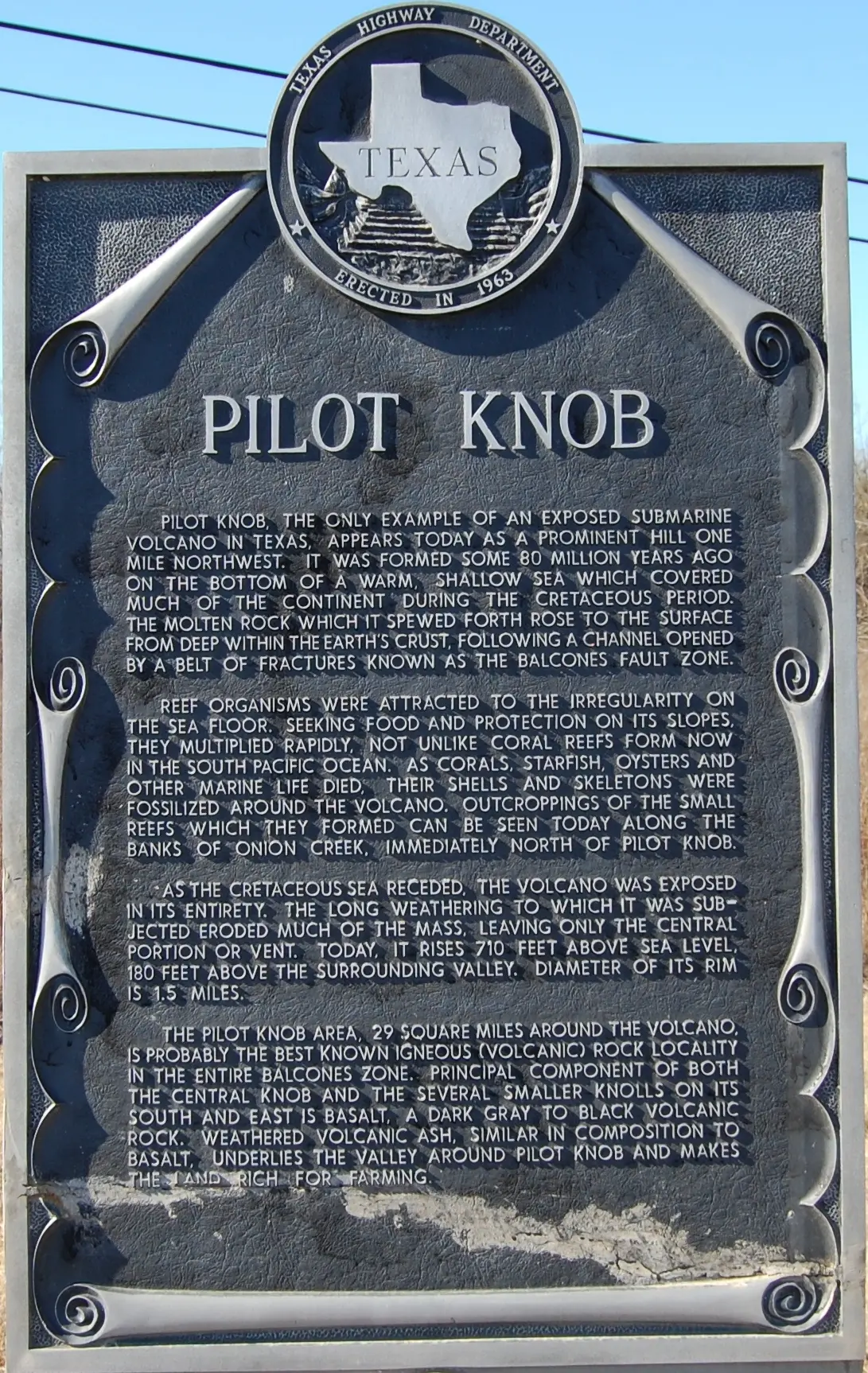
A 1963 state historical marker stands along the road at the volcano's edge, quietly announcing one of the strangest facts in Texas geology to anyone who pulls over: you are standing in a volcano.

Interlude Prime time · January 25, 2021
The night Pilot Knob erupted on TV.
In season 2, episode 2 of FOX's 9-1-1: Lone Star — titled “2100°” — Austin's sleepy volcano wakes up with spectacular bad manners.
The episode opens at a miniature golf park, where the ground splits into a broiling lava trench mid-putt and the crew of the 126 has to rope in for a rescue on red-hot rock. Then, as the firefighters pack up, Pilot Knob itself erupts on the horizon — kicking off a night of volcanic emergencies across Austin, from a lava-bombed college pool party to a food truck under siege by heat-crazed scorpions.
Credit where due: the writers picked a real volcano, and the title is real science — basaltic magma genuinely runs around 2,100°F. The rest, mercifully, is television.

On screen
- Erupts without warning on a Monday night
- Lava swallows a mini-golf course
- Ash cloud shuts down the city
- Scorpions get involved
In the rock record
- Last eruption: ~80,000,000 years ago
- Magma source: long gone — it's a one-shot “monogenetic” volcano
- Current hazard level: cows
- Scorpions: present, but calm
Epilogue The mini-golf coincidence · today
On TV, the volcano came for the mini golf.
In real life, the mini golf came to the volcano.
Here's the punchline the writers of “2100°” probably never knew: there really is a miniature golf course in the volcano's neighborhood.
Duke's Adventure Golf, a family-run, mining-themed 18-hole course that opened in 2017, sits on East Slaughter Lane in southeast Austin — just a few miles from Pilot Knob's crater ring. Which means that somewhere in Austin right now, someone is lining up a putt through a fake mine shaft, within eyeshot of a genuine extinct volcano, blissfully unaware they are living inside the premise of a network television disaster episode.
The volcano has held its fire for 80 million years. The windmill hole remains the greater hazard.